
Checking Criminal History in Iowa County
Begin with the record that answers the question. Iowa Courts Online is the public index for criminal charges filed in Iowa District Court. The Iowa County Jail is the direct source for a person who may be in local custody, because Iowa County does not publish a web inmate roster. The arresting agency keeps its own incident or arrest report. For a statewide Iowa history, use the Iowa Department of Public Safety, Division of Criminal Investigation, Records and Identification Unit rather than asking the county clerk for a rap sheet.
Collect a full name, exact date of birth when the official form permits it, likely spelling variants, the event date, and any case or report number. These details reduce false matches and help staff locate a narrow request. Then follow the channel that fits:
- Search Iowa Courts Online by participant name or full case number and select Iowa County.
- Read the county, case type, filing date, status, and each charge disposition before deciding that a result matches.
- Call the Iowa County Jail for current custody or very recent booking facts that may precede a court filing.
- Ask the agency that made the arrest for its incident or arrest report under Iowa Code chapter 22.
- Order the DCI statewide record product when the question reaches beyond Iowa County case files.
The official Iowa County government site shows the county departments that route local records.

That directory helps separate the clerk, sheriff, and county attorney instead of sending one broad request to the wrong office.
Iowa County Records Use Three Offices
A booking entry, a court file, and a DCI history are not three views of one database. They are separate Iowa County criminal records made at different stages. The sheriff and jail document the arrest, intake charges, bond, custody, and release. The Clerk of District Court records the complaint or trial information, later motions, pleas, orders, judgment, sentence, and money due. DCI links fingerprint-supported arrest cycles to dispositions reported by courts and justice agencies.
This difference explains many apparent conflicts. An officer may use a probable-cause charge at intake. The county attorney can file a different count, amend it, or decline it. The court then decides each filed count. DCI may receive the final disposition after the local docket changes. Use the jail record for custody facts, the court file for what was charged and decided, and the DCI response for the releasable statewide history.
The county history page documents the courthouse that remains central to this split records system.
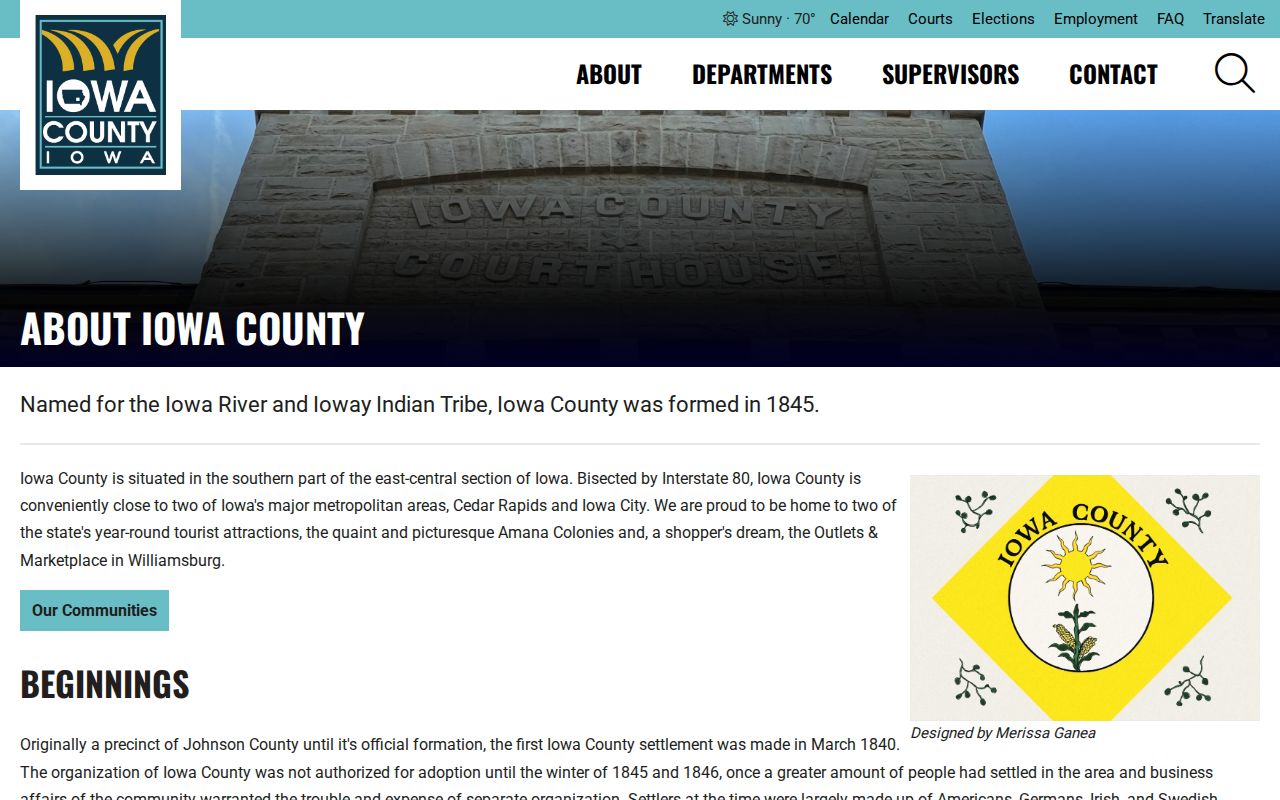
The 1892 stone courthouse still houses the route to Iowa County court files, while arrest and jail records are kept at Franklyn Avenue.
Iowa Official Background Checks
The Iowa DCI Records and Identification Unit offers Iowa Record Check Online and accepts mail, fax, email, and in-person requests. It does not take record-check requests by phone. The minimum subject details are first name, last name, and exact date of birth. Middle name, sex or gender, and Social Security number are optional identifiers that can help distinguish common names.
Each last name costs $15. An alias or former surname needs another request and fee. A signed release is not required for the basic public request, but its absence changes what DCI may release. Without authorization, DCI withholds completed deferred judgments and arrests more than 18 months old when no final disposition is recorded. Juvenile information is generally confidential.
The DCI source shows the official product and its request routes.
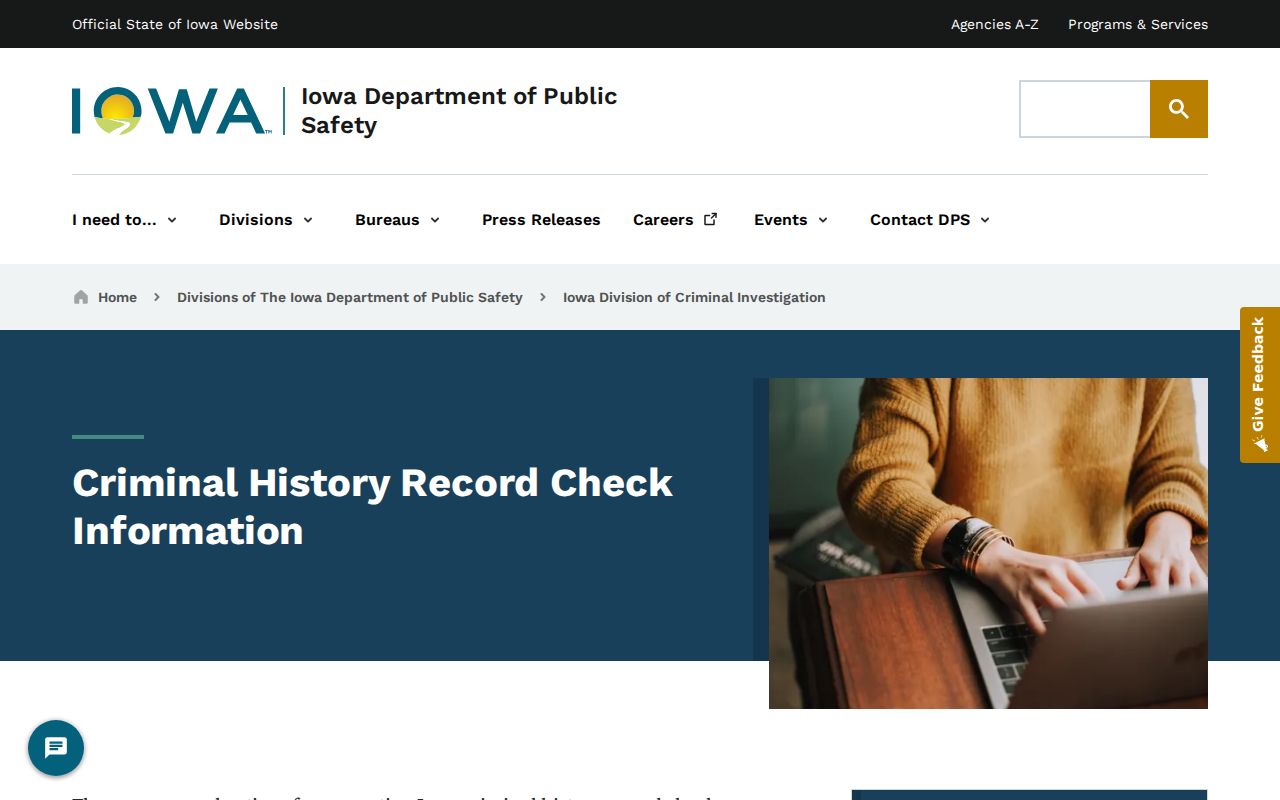
This statewide response should be read under Iowa Code chapter 692, not as a copy of every sheriff report or court document.
| Request item | Cost or rule |
|---|---|
| One last name | $15 |
| Alias or former surname | Separate $15 request |
| County resident fingerprint card | Free at the Iowa County Jail |
| Nonresident fingerprint card | $10 exact cash |
Iowa County Fingerprint Service
The Iowa County Jail provides applicant fingerprint-card service at 960 Franklyn Avenue in Marengo. Regular service is available on weekdays from 8:30 a.m. to 4:30 p.m.; after-hours and weekend service is by appointment. Bring the fingerprint cards and valid photo identification. County residents are printed without charge, while nonresidents pay $10 in exact cash. Court-ordered criminal fingerprinting uses the same weekday window.
Fingerprint capture is a service, not the finished history. DCI maintains the Iowa repository, and the FBI offers its own Identity History Summary for personal national record review. The purpose and receiving agency determine which card and submission route are required, so confirm those details before visiting the jail.
The sheriff's fingerprinting page gives the local requirements.
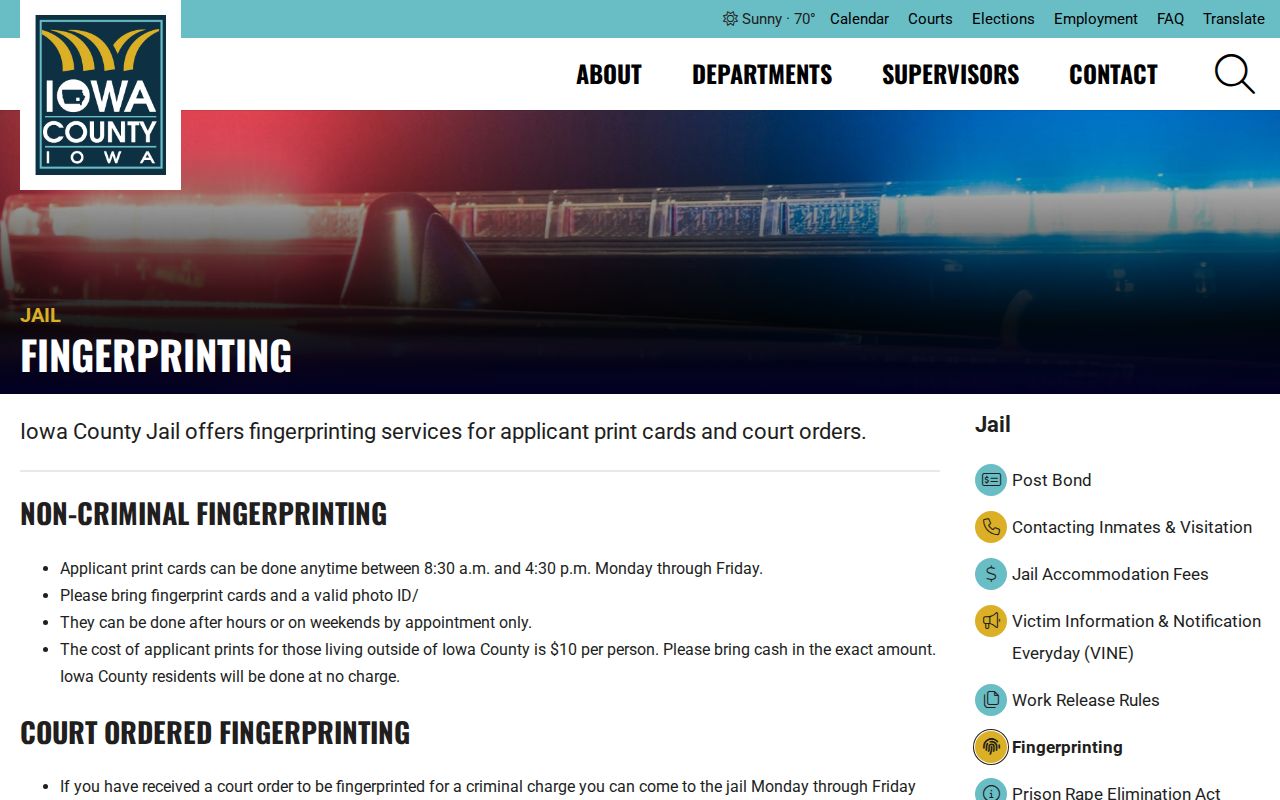
The page is the best source for current hours, identification rules, and resident pricing before a trip.
Criminal Record Types
Iowa County criminal history work becomes clearer when each record is named precisely. A broad request for “everything” may reach an office that holds only one part. The most useful categories are:
- Incident and arrest reports: agency narratives about the event, probable cause, place, and law-enforcement action.
- Booking records: jail intake data such as custody time, arresting agency, charge at intake, bond, and release.
- Criminal court files: complaints, trial information, appearances, motions, pleas, dispositions, judgments, and sentences.
- DCI histories: releasable statewide fingerprint-supported arrest and disposition cycles.
- Warrant and supervision records: court and law-enforcement warrant facts plus public DOC probation, parole, or custody status.
- Registry records: the public data allowed through the Iowa Sex Offender Registry, which is not a complete background check.
Juvenile, confidential, restricted, and expunged records may not appear in a public search. Absence is therefore not proof that no protected record exists.
Iowa County Jail Has No Roster
The Iowa County Jail page identifies a 46-bed facility that opened in 2006, but it does not provide a live inmate search. For current custody, call 319-642-7307 extension 2 or ask at the sheriff and jail counter. A filed case may later appear in Iowa Courts Online. VINE can supply custody notifications, and Iowa DOC Offender Search becomes relevant after transfer to state custody or supervision.
The absence of a roster does not erase booking records. It changes the access method. Ask for a narrow booking fact or describe the exact jail record sought. The county does not publish a verified online inventory of photographs, physical descriptions, housing locations, or warrant fields, so none of those should be assumed available.
The official sheriff page identifies the office, jail, and contact routes.
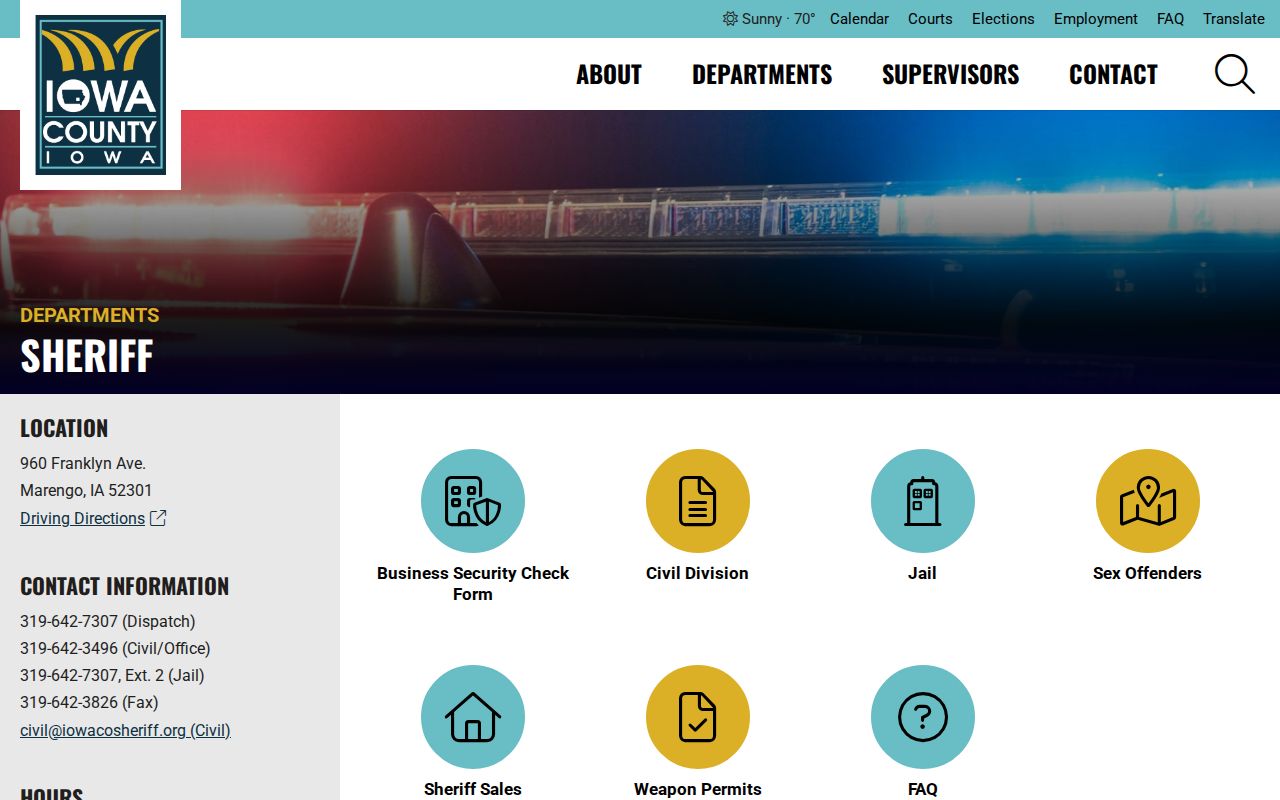
It leads to the county's jail, fingerprinting, visitation, and sex-offender functions without presenting a public booking blotter.
Inside an Iowa County Criminal Record
The fields depend on the custodian. Match the subject with more than a name, then read each count and date separately. A common name, amended charge, or late disposition can otherwise attach the wrong meaning to an Iowa County record.
| Name and identifiers | Displayed name, aliases where releasable, date-of-birth detail, party role, or agency identifier. |
|---|---|
| Arrest and booking | Arresting agency, arrest and intake dates, charge presented at intake, bond, custody, and release when public. |
| Charges and statutes | Count number, description, Iowa Code citation, level, offense date, and later amendment. |
| Disposition | Dismissal, acquittal, plea result, conviction, deferred judgment, or another outcome for each count. |
| Sentence | Jail or prison term, probation, fine, costs, restitution, and related orders when publicly filed. |
| Custody or supervision | Public jail, Iowa DOC incarceration, probation, or parole status, subject to system limits. |
A docket is the date-ordered list of court events. A disposition is how a charge ended. A deferred judgment postpones judgment while conditions are completed and is not the same as an ordinary conviction. These terms should be checked against the actual order, not inferred from one status label.
Iowa County Warrants Need Confirmation
No official online Iowa County active-warrant portal was found. Call sheriff dispatch at 319-642-7307 or contact the issuing court and clerk. Iowa Courts Online may show a failure-to-appear event or another docket entry, but it is not guaranteed to show current warrant status in real time. Arrest warrants authorize custody, bench warrants often follow nonappearance or violation of a court order, and search warrants may remain sealed during an investigation.
To resolve a possible warrant in your own name, obtain the case number, charge, issuing court, bond conditions, and the office's surrender or payment instructions. Do not assume that an unofficial list is current or that cash will clear every warrant. After action is taken, allow time for systems to update and confirm again with the issuing office.
Note: A court docket can point to a warrant event, but only the sheriff or issuing court can confirm its present status.
Public Access Laws in Iowa
The Iowa Open Records Law gives a right to inspect and copy public records, but it does not make every field or file public online. The record type, custodian, active-investigation status, juvenile status, authorization, expungement order, and court restriction all affect access. A chapter 22 request to the sheriff can seek a specific incident report, booking entry, call record, audio file, or video, though lawful costs and redactions may apply.
Key Iowa rules:
Iowa Code §22.2 establishes the right to examine and copy public records, subject to lawful exceptions.
Iowa Code §22.3 requires reasonable access and permits reasonable fees.
Iowa Code §22.7 identifies confidential records that may be withheld.
Iowa Code §692.2A controls dissemination of criminal-history data and authorization-based release differences.
Iowa Court Rule 16.201 et seq. governs electronic filing and access without overriding statutory restrictions.
Describe the record, date range, location, incident or case number, and preferred format. The Iowa County Sheriff has no published criminal-report form, fixed copy schedule, or guaranteed turnaround, so ask about cost and routing before ordering.
Iowa County Supervision Records
Iowa County is served by the Sixth Judicial District Department of Correctional Services. The court judgment is the first source for a probation sentence. Iowa DOC Offender Search may then show qualifying custody or community-supervision information, including a public status and supervising district. Detailed case plans, treatment files, risk assessments, medical information, victim data, and home street addresses are not general public lookup fields.
The Sixth District source identifies the local community-based corrections structure.

This district role differs from the Iowa Board of Parole, which makes parole decisions, and from the clerk, which records the sentence.
The Iowa Board of Parole publishes its own policies, meetings, and contact path.
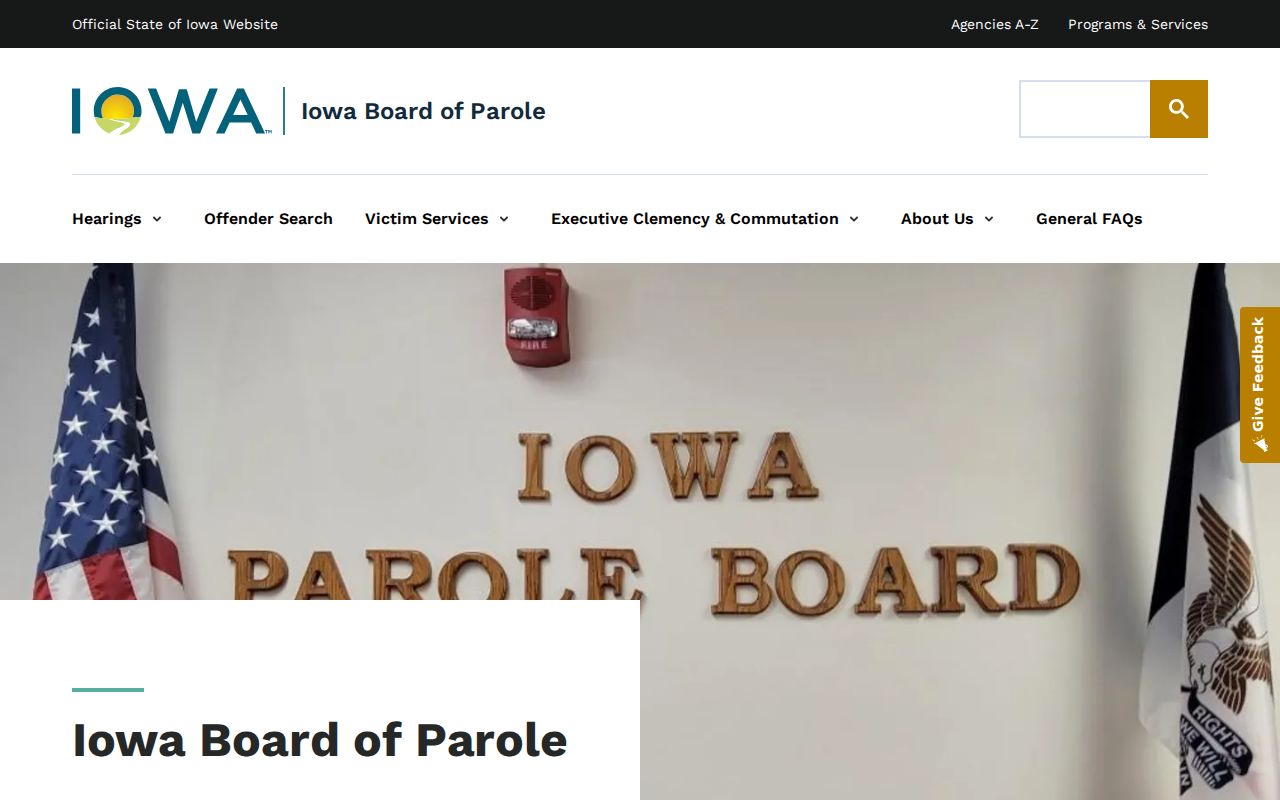
Board material may be public under governing rules, while confidential correctional files remain restricted.
Sealed, Expunged, and Restricted Records
Iowa has limited expungement routes rather than one broad remedy for all adult convictions. Iowa Code chapter 901C includes relief for specified dismissed or not-guilty cases when statutory conditions are met. Section 907.9 addresses discharge after a deferred judgment and expungement of the court record. Other narrow offenses have separate provisions. Juvenile files, confidential records, and court-restricted documents follow their own rules.
A crucial split remains after some deferred judgments. DCI states that it retains the history marked “discharged” even when the court record is expunged, treats it as a nonconviction, and releases it only with signed authorization. After an order, verify both the public court result and the DCI history. A portal status alone cannot prove eligibility or show that every source has changed.
For an Iowa County case, identify the case and use current Iowa Judicial Branch forms where applicable, then file through the Clerk of District Court or EDMS. Confirm any fee with the clerk because no county-specific expungement fee was found in the official research.
Iowa DOC Starts After County Jail
The Iowa DOC Offender Search covers qualifying state custody and supervision, not every stay in the Iowa County Jail. Search by a name or state identifier and confirm status, committing county, and custody or supervision location. A person may be absent because the detention remains local, release has occurred, the name differs, or the record is not part of the public DOC product.
The state locator displays the corrections channel used after an Iowa County sentence reaches DOC custody or supervision.
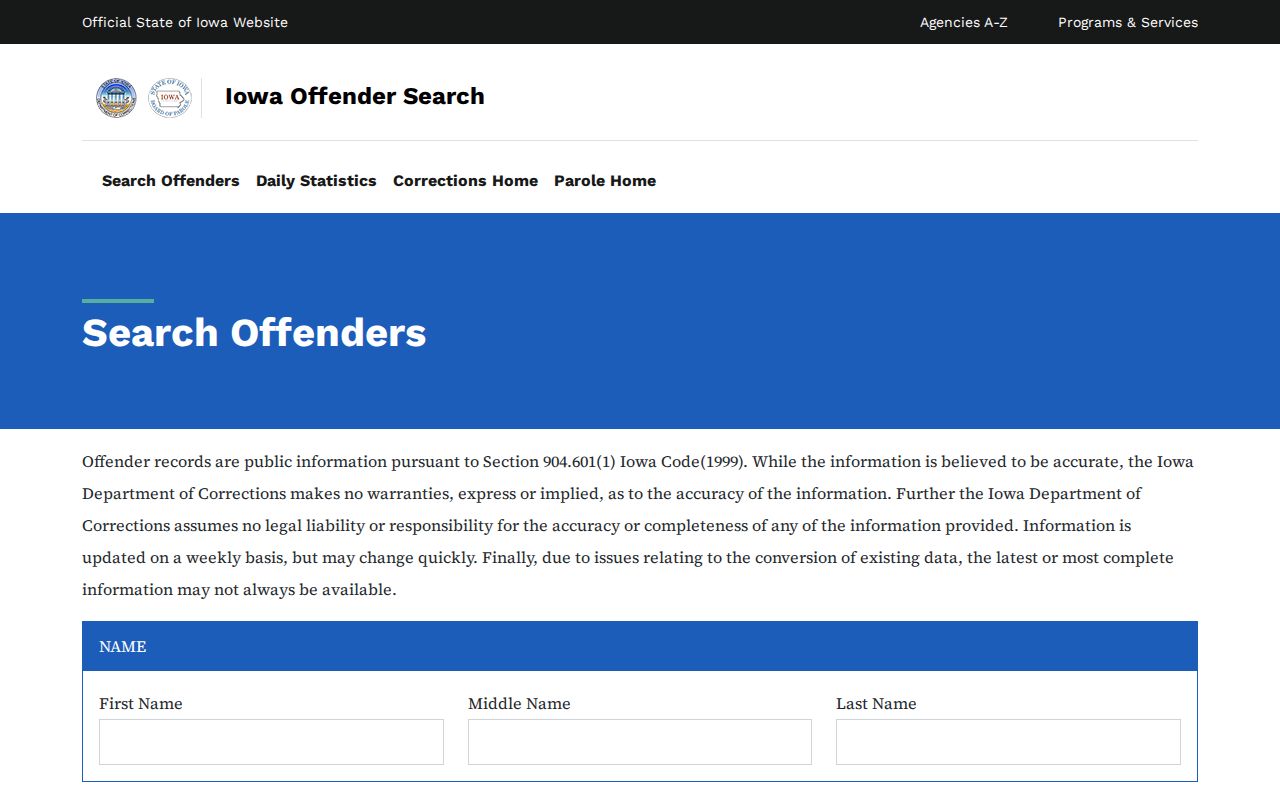
Use the court judgment for the sentence and the DOC result for current public status. VINE is best treated as a notification supplement rather than the court record.
Iowa County and Federal Records
Iowa County lies in the Cedar Rapids Division of the U.S. District Court for the Northern District of Iowa. Federal cases are not complete in Iowa Courts Online. PACER is the federal docket and document system, requires registration, and may charge fees under its current schedule. The FBI Identity History Summary is the personal fingerprint-based national review channel. Federal custody uses the Bureau of Prisons locator rather than Iowa DOC.
The official PACER source shows where a federal Iowa County case search begins.
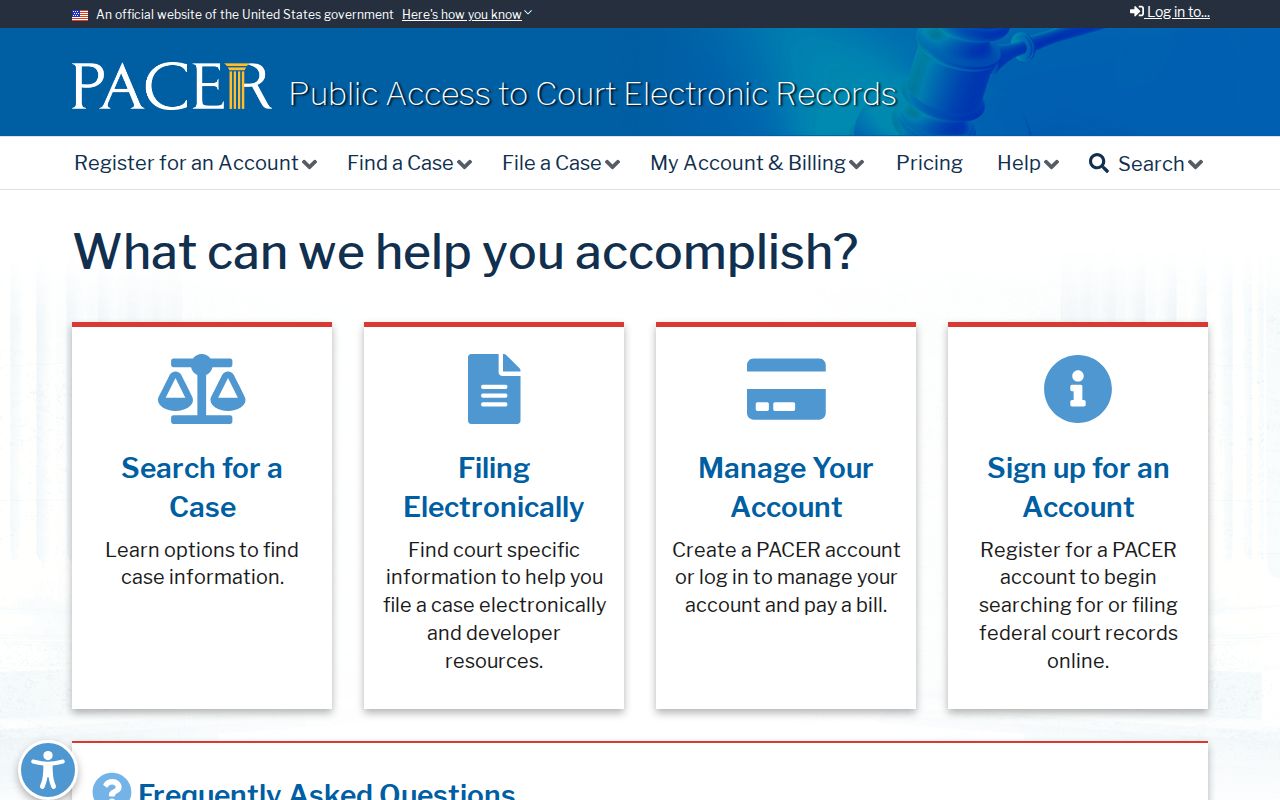
Sealed cases and nonpublic federal warrants do not become available merely because a PACER account exists.
Iowa County Criminal Records by City
Williamsburg, Marengo, and North English are the three largest incorporated places in the official 2020 Census ranking used for Iowa County. City-level records still depend on who created them. Williamsburg and Marengo police reports remain with those departments, county sheriff records stay at Franklyn Avenue, and filed cases use the unified Iowa District Court system. North English crosses into Keokuk County, so the incident address can change the sheriff, jail, county filter, and clerk.
Williamsburg Criminal Records
Population 3,346 in 2020. Confirm whether Williamsburg Police, the sheriff, or State Patrol made the record.
Marengo Criminal Records
Population 2,435 in 2020. City police, sheriff, clerk, and prosecutor use separate nearby offices.
North English Criminal Records
Population 1,065 in 2020. The cross-county boundary makes the event address vital.
Iowa County Is Not Iowa City
Iowa County and Iowa City are different jurisdictions. Iowa City is in Johnson County. A search using only “Iowa City” can lead to the wrong sheriff, jail, and clerk even when the case belongs in Iowa County. For a case filed here, select Iowa County in Iowa Courts Online and use the clerk in Marengo. For an arrest report, confirm the precise event location and arresting agency.
The county was formed in 1845, and Marengo was chosen as its seat that year. Its courthouse opened in 1892. Interstate 80, Williamsburg traffic, the Amana area, and small communities mean an event may involve city police, the Iowa County Sheriff, or Iowa State Patrol. Agency and county fields are therefore more reliable than a place name alone.
Note: Match the incident address, agency, and filing county before ordering a record or traveling to a counter.