
Sex Offender Checks in Iowa County
The Iowa Sex Offender Registry is the first source for a public Iowa County sex offender search. The Iowa Department of Public Safety and its Division of Criminal Investigation manage the statewide system under Iowa Code chapter 692A. Searchers may work from a known person’s name or from a place, such as Iowa County, Williamsburg, Marengo, North English, a ZIP code, or a street and radius. Place searches help with community awareness. Name searches work best when the first and last names are paired with other profile facts.
The Iowa County Sheriff sex-offender page supplies the local route. The sheriff participates in registration and verification, but the county page is not a separate full registry or a substitute map. For an underlying public conviction, use Iowa Courts Online and the clerk. For a broader releasable Iowa history, DCI offers its own record-check process. These products answer different questions.
Note: A blank result from one spelling or address search does not prove that no registration record exists.
Iowa County Registry Search Paths
A person search and a geographic search should not be treated as exact duplicates. The name route is useful when a searcher already has an identity to verify. The city, Iowa County, ZIP, and address-radius tools are built for place-based awareness. Start broad enough to avoid a missed match, then narrow with first name, city, or other facts. Switch between list and map controls when the interface offers both views.
The state registry is the source record for Iowa County results. A map pin is a search aid, not a legal finding about a property or person. Some geographic detail may be limited by statute or classification. If a result could involve the same name as someone else, open the profile and compare several public fields before reaching any conclusion.
How to Search the Iowa Sex Offender Registry
The official interface combines person, Iowa County, city, ZIP, and map-based controls. Its labels may change, so read the live instructions and terms before searching. The following route keeps an Iowa County offender lookup tied to the official source.
- Open the Iowa registry and read its conditions of use.
- Enter a last name, or choose a geographic route such as Iowa County, city, ZIP code, or address and radius.
- Add a first name or other location detail to narrow likely matches.
- Review both list and map results, then open the full profile and compare several identifiers.
| Field Label | Type | Required | Notes |
|---|---|---|---|
| Last Name | Text | Search-dependent | Main person-search field |
| First Name | Text | Optional | Helps narrow common names |
| City | Text or select | Optional | May be used for Williamsburg, Marengo, or North English |
| County | Select | Optional | Select Iowa County for a county view |
| ZIP Code | Text | Optional | Narrows a geographic search |
| Address and Radius | Address, distance, and map | Optional | Supports nearby geographic results |
| Search or Reset | Buttons | No | Runs or clears the query |
The official Iowa registry search screen shows how the state organizes these public controls.
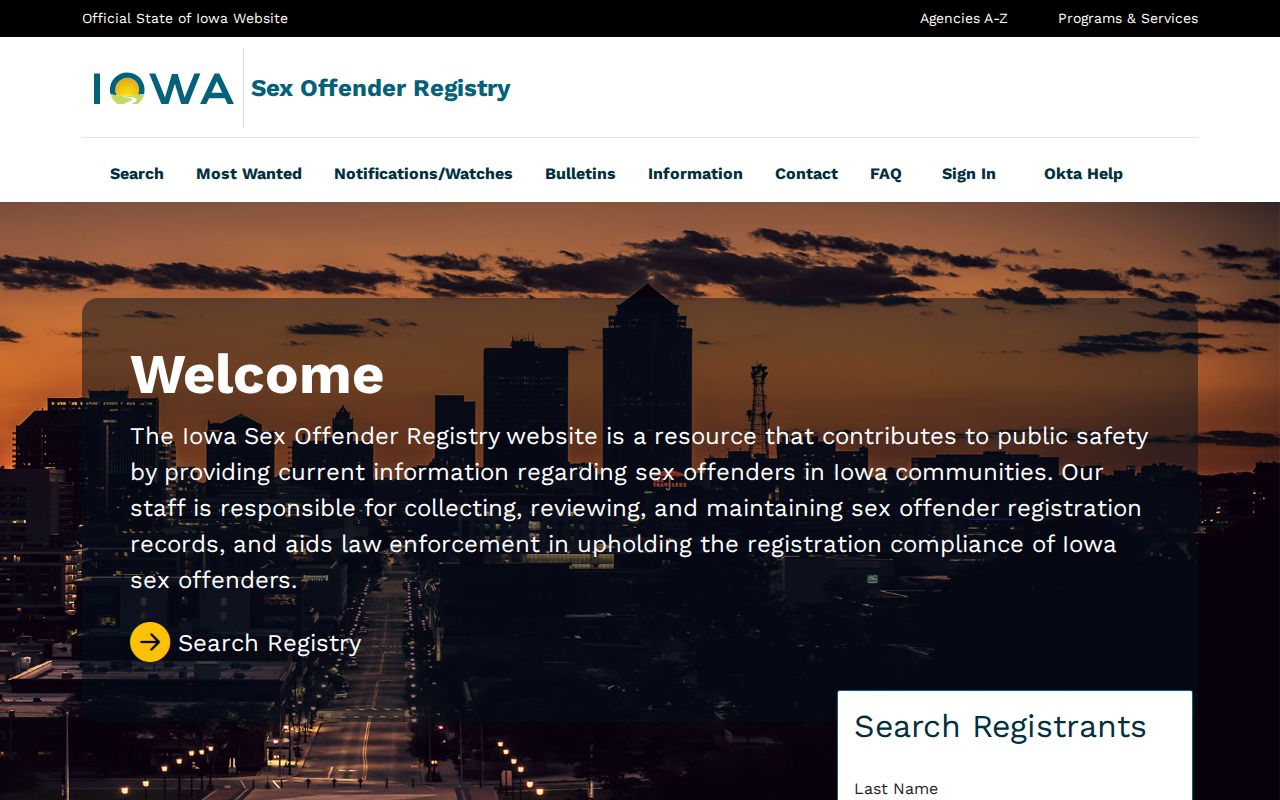
The captured interface reinforces why the county filter and map tools should be used with the profile details, not read in isolation.
Iowa County Sheriff Registration Role
Local registration questions go to the Iowa County Sheriff’s Office and Jail at 960 Franklyn Avenue, Marengo, IA 52301. The office line is 319-642-3496, dispatch is 319-642-7307, and the public office hours listed by the county are weekdays from 8:30 a.m. to 4:30 p.m. The sheriff’s role includes local registration and verification work. It does not turn the sheriff page into a complete county list.
Iowa County Sheriff
960 Franklyn Avenue
Marengo, IA 52301
Office: 319-642-3496
Dispatch: 319-642-7307
The county registration contact page points residents from local questions to the state source. The county’s department directory provides a second official route if a number or office listing changes.
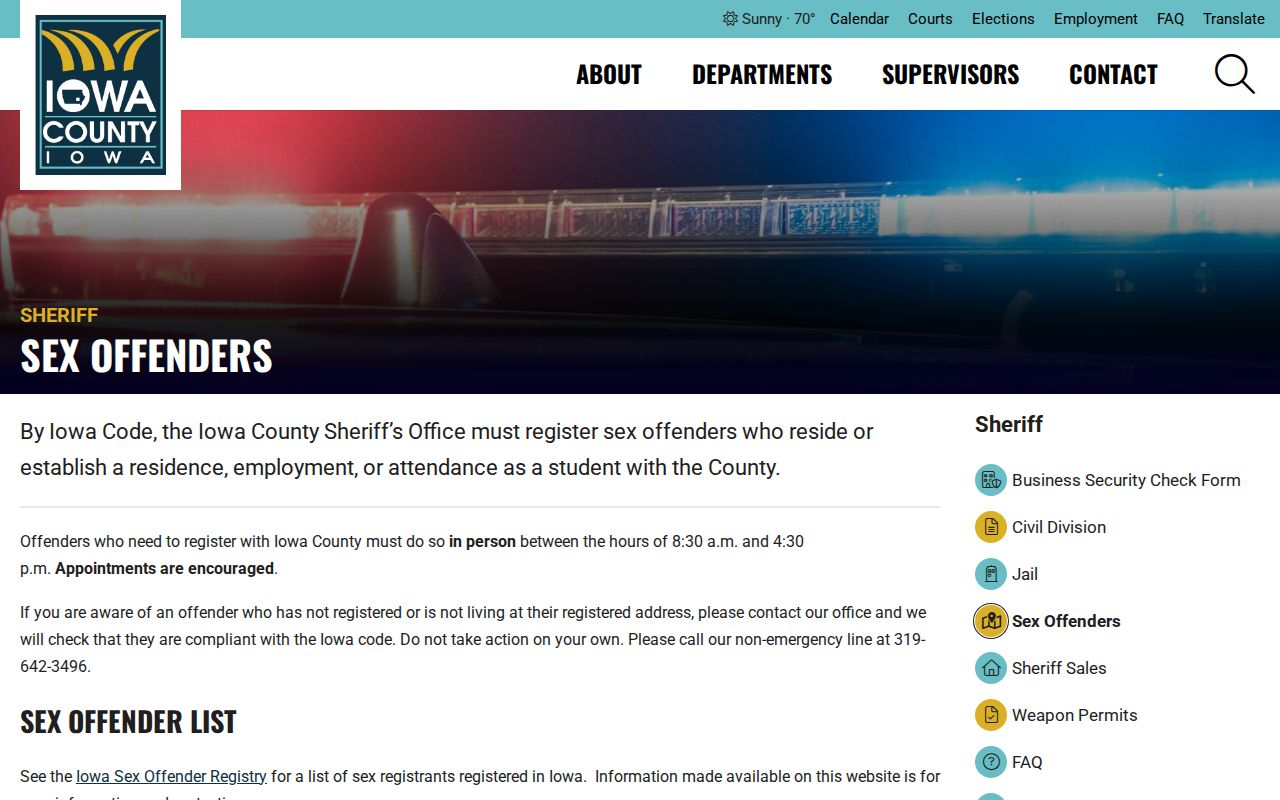
That division of work matters: the sheriff can address a county registration concern, while the state registry supplies the public search.
Inside a Registry Profile
An Iowa County registry profile is a notification record. It can combine identity traits, registration status, location information permitted for display, and offense details. It is not the judgment PDF, the county booking record, or a complete DCI rap sheet. Compare enough fields to reduce the risk of confusing two people with similar names.
| Name and Aliases | Legal name, known aliases, and a registry identifier may appear. |
|---|---|
| Photo and Description | A current photograph and public physical traits may include approximate age, sex, race, height, weight, hair, eyes, and marks. |
| Location | Residence or permitted geographic details, city, and county may be displayed as the law allows. |
| Offense | Description, jurisdiction, statute, conviction date, and a permitted victim-related category may appear. |
| Other Registration Data | Vehicles, schools, or other registered information can appear when public release is authorized. |
| Status | Registration or compliance status and the supervising or registration agency may be shown. |
A missing field on one Iowa County profile is not proof that the fact was never reported. Public-display rules, the record itself, and the live interface determine what appears.
Read the offense entry as a pointer to the source case, not as a full account of the prosecution. Iowa Courts Online can identify the Iowa County case number, filed charge, docket events, and public disposition. The Clerk of District Court can address access to an available document. A jail record instead describes custody, and a DCI record check compiles releasable fingerprint-supported history from across Iowa. Keeping those sources separate prevents a registry profile from being asked to answer facts it was not designed to show.
Iowa County Registry Address Limits
Iowa County address-radius results can help a family review an area, but the map is not a legal boundary survey. Iowa residence restrictions and exclusion zones depend on current chapter 692A and the specific facts. A pin alone does not establish whether a home, school, or other site is inside a prohibited zone. Nor should a stale copied address replace the live state record.
If a location looks wrong, first check the spelling, city, ZIP code, and search radius. Then compare the list view with the map and open the related public profile. A suspected registration discrepancy should go to the Iowa County Sheriff or the registry. Do not approach or confront a person at the address.
Note: Call 911 for an emergency; use the sheriff or registry channel for a non-emergency registration discrepancy.
Iowa Registration Levels and Requirements
Iowa does not reduce every public registration issue to a simple low, medium, or high consumer risk label. Chapter 692A ties duties and duration to statutory offense classifications and other facts. Section 692A.106 governs duration. Section 692A.104 addresses verification and change-reporting duties. The current code must be checked before drawing a conclusion about one person.
| Statutory Concept | General Duration | What Controls |
|---|---|---|
| Qualifying registration | Generally ten years | Offense classification and statutory circumstances |
| Specified aggravated, repeat, or sexually violent matters | Lifetime may apply | Chapter 692A classification and case facts |
| Verification and changes | Frequency and deadlines vary | Section 692A.104 and related provisions |
Residence, employment, school, and other changes must be reported within the time set by law. Ten-year and lifetime terms describe registration duration, not a stand-alone risk score. Court records remain the better source for the charge, judgment, and sentence behind a public registry entry.
The exact Iowa County verification schedule and duration can turn on the qualifying offense, prior matters, and other statutory conditions. A public label should never be used to guess those facts. For an Iowa County registration question, compare the live profile with the current chapter 692A text and contact the sheriff’s office. That source-based route is more sound than applying a three-tier chart borrowed from another state.
Iowa County NSOPW Cross-State Search
The National Sex Offender Public Website, or NSOPW, adds a federal search layer across participating jurisdictions. It can help when an Iowa County person or address question crosses state lines. For an Iowa County result, however, return to Iowa’s registry for the source profile and use the local sheriff for a county registration concern. NSOPW does not replace state correction, court, or criminal-history records.
The national portal presents a broad public search route without turning its result into a full background record.
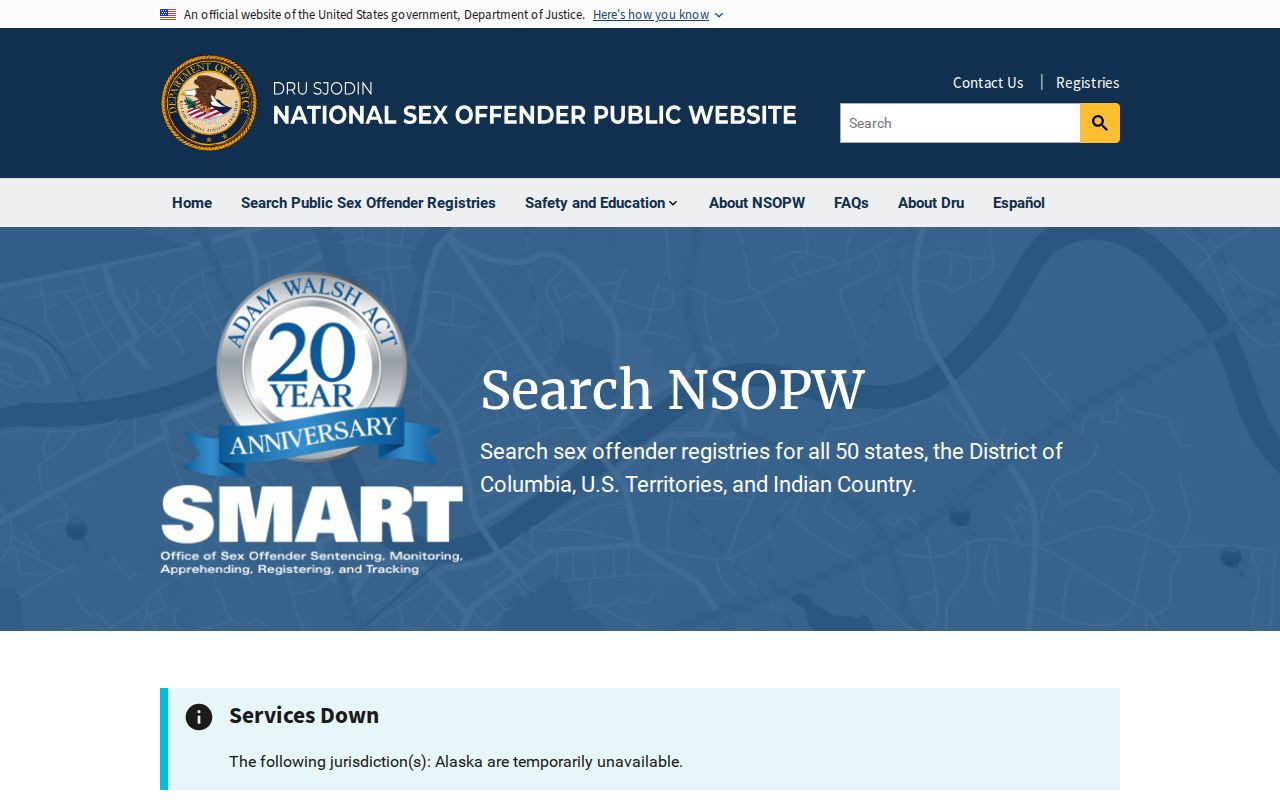
This cross-state view is most useful as a supplement when location history may extend beyond Iowa.
Community Notification and Lawful Use
Iowa County registry information supports personal, family, and community awareness. Verify identity with several fields and rely on the current official map instead of copying an address into an informal list. A registry absence does not guarantee that a person has no criminal history. It means only that the public search did not return statutorily registerable information under the terms entered.
Use registry information lawfully: Iowa Code §692A.121 bars using public registry data to threaten, intimidate, harass, or unlawfully discriminate. Misuse can bring criminal or civil consequences.
The current text of Iowa Code chapter 692A controls public availability, registration duties, and restrictions. Safety concerns should go to law enforcement. The public should not confront a registrant or anyone else at a listed address.
Iowa County Registry Discrepancies
An Iowa County result that appears stale, incomplete, or misplaced calls for a careful source check. Save the registry identifier or public profile reference, note the precise field at issue, and contact the Iowa County Sheriff or the state registry. Avoid spreading the disputed detail while officials review it. The sheriff can address the local registration route, while DCI controls the statewide public system.
For the underlying case, search Iowa Courts Online and select Iowa County. The court file can show the filed count, disposition, and judgment that the registry summary does not reproduce. A formal chapter 22 request may be used for a specific public agency record that is not already supplied, but it does not open protected investigative or registration data.